
The Immovable Yungang Grottoes Leave Home to Travel the World
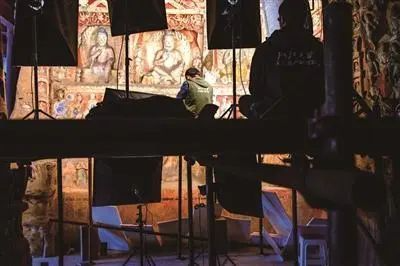
Zhejiang University’s digitization team records the front chamber of Yungang Cave 12
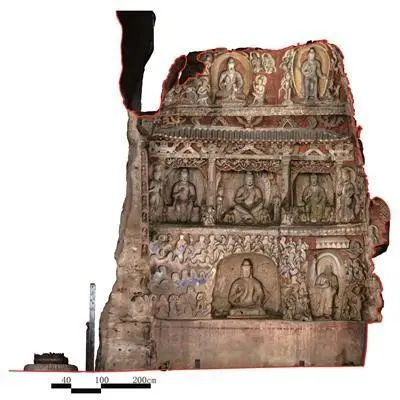
Orthophoto of the west wall of the front chamber of Yungang Cave 12, digitally mapped from records of the original form and color

Detail of the replica cave
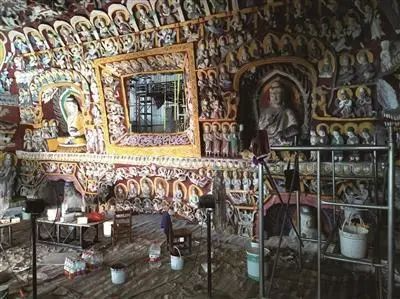
Painting the replica
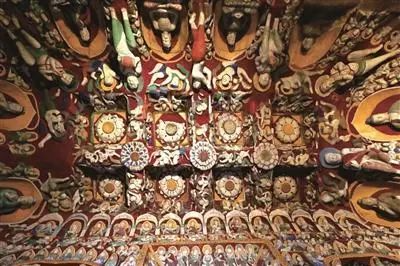
Ceiling of the replica cave’s front chamber
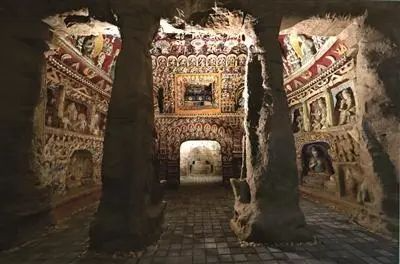
Full view of the replica cave
“Carved into the mountain, built into the living rock, its immense and majestic figures are scarcely equaled in the world.” That was how the Northern Wei geographer Li Daoyuan described the Yungang Grottoes in his Commentary on the Water Classic. Today, visitors need not travel to Datong, Shanxi, to see the intricate carvings of music and dance or the distinctive style for which Yungang is famous. A second cave can travel wherever it is exhibited. For its first world tour stop, Yungang has left Mount Wuzhou in Datong, its home for more than a millennium, for the Zhejiang University Museum of Art and Archaeology. From June 12 the museum is exhibiting the world’s first movable 3D-printed replica cave, a collaboration between Zhejiang University and the Yungang Grottoes Research Institute. Visitors can see Cave 12 in detail. Its sculptures and celestial musicians turn the walls into a vast concert. One visitor wrote on Weibo, “The 3D-printed cave is so cool! Ancient wisdom and modern technology make a wonderful combination.” Over three years, researchers from Zhejiang University’s Institute of Cultural Heritage and the Yungang Grottoes Research Institute solved problems in data capture and processing, structural design, printing sections and painting. The replica fulfills the institute’s longstanding wish for Yungang to travel.
A Longstanding Wish
Taking an immense cave on tour. Sixteen kilometers west of Datong, the Yungang Grottoes are an internationally known treasury of Buddhist art. This World Heritage site is more than 1,500 years old. Its 45 surviving caves contain over 59,000 statues and countless ornamental designs, outstanding examples of fifth-century sculpture. The Yungang Grottoes Research Institute had long wanted to take these vast spaces on tour so that more people could experience their art firsthand. In April 2014 it formed a strategic digital conservation partnership with Zhejiang University’s Institute of Cultural Heritage. The university would help capture and model Yungang in 3D, creating models viewable on a computer and permanently recording the caves and their artifacts. Although the university institute was founded in 2010, this work dates to 1997, when Zhejiang University academician Pan Yunhe pioneered research into information technology for archaeology, conservation and art reconstruction. “Our first use of 3D for heritage was at Dunhuang,” recalled Deputy Director Diao Changyu. “We developed a virtual tour that let you explore the caves on a computer like a 3D game. It was shown at Expo 2000 in Hanover, Germany.” While building the Yungang models, the partners asked whether they could take the caves beyond the screen and display an immovable site in physical form elsewhere. A virtual system alone could not meet that aim, so the Zhejiang team began to consider 3D replication. “The Yungang institute encouraged us to experiment. We also thought it was a promising research direction, so we began the trials,” Diao said.
Exploring the Options
More than two years of experiments before choosing 3D printing. Turning the idea into a physical cave was particularly difficult at Yungang. “The grottoes are all sculpture. We kept trying 3D printing, but the cost was high and there were technical problems to solve.” The Zhejiang team compared speed, cost, accuracy, results and materials for different processes. A touring cave had to be light, so after testing natural and synthetic materials the team chose a lighter synthetic material. They also compared additive processes, which build the form up, with subtractive ones, which cut it from a block. “We tested 3D carving. High-precision CNC machining can produce excellent replicas, but it puts strict demands on the material. Keeping lightweight material rigid enough under cutting forces to preserve accuracy was a challenge.” Weight and precision were difficult to reconcile. The trial also revealed the limits of machining. “Yungang has an enormous variety of sculpted forms,” Diao explained. “In a complex group one figure can block the cutter’s access to another. You have to separate the figures and machine them individually, which makes the job much more difficult.” Additive printing avoided that issue. After more than two years of research and trials, the team chose 3D printing. Zhejiang University’s Institute of Cultural Heritage and the Yungang Grottoes Research Institute formally launched the movable 3D-printed cave project in August 2016. The Yungang institute led scholarship and hand coloring, Zhejiang University led development of key technologies, and Shenzhen MIC Technology Co., Ltd. handled printing and structural fabrication. Shanxi Yungang Digital Technology worked principally on hand coloring. The institute and university worked together on 3D capture and processing. The three teams had undertaken what once seemed impossible.
A Data Bottleneck
Processing the scans pushed the limits of the field. Carved in the fifth century, Yungang Cave 12 is also known as the Music Cave. Its richly colored celestial figures play instruments of Chinese and foreign origin in a representation of an ancient court orchestra. The carvings document the music, dance and tastes of their era. The front hall and rear chamber together measure 14 m deep, 11 m wide and 9 m high. Their dimensions made the replica practical to transport and exhibit, so the Yungang institute chose Cave 12. “Recording this cave pushed the limits of the field,” Diao Changyu recalled. The sheer size of the space, the use of both high and low relief, and the varied depths and scales of the carvings made scanning and surveying exceptionally difficult. The partners combined 3D laser scanning with photogrammetry using a method developed at Zhejiang University. In three months they scanned from 52 stations and took 55,680 photographs. Algorithms then had to bring the images and scans together. By constraining one set of observations against another, they could fill blind spots and improve accuracy. But the volume of high-resolution data and computation was a major obstacle. “What struck us was how hard it was to process the data. The computers couldn’t finish it, the time required by existing software was far beyond what we could accept, and sometimes we couldn’t even tell when a program might finish,” Diao said. The other two partners had to wait, putting the team under pressure. Four doctoral and master’s researchers went back to the underlying algorithms and found a way to integrate data from different instruments. Their breakthrough allowed them to complete a high-fidelity, full-color 3D model in the time available. “It was still about six months later than I had promised,” Diao said with a smile. “We thought processing would take half a year. It took about a year.”
Making the Replica
With no precedent, every stage posed a challenge. When MIC Imaging in Shenzhen finally received the processed data, the first obstacle was the small volume that could be printed in one piece. Problems and experiments became part of daily life. “Every stage brought something new. We were the first team to do this, with no technical model or case to follow. We were bound to hit obstacles as we found our way.” MIC Imaging developed large printers with a 1 × 1 × 1.5 m build volume and built 20 of them. Their 3D-printed molds could reproduce the fine details of the original in a single print for each small section. Cave 12 was divided into 110 blocks about two meters square, each subdivided into roughly a dozen printable pieces. Each small piece took nearly a week of uninterrupted printing. Rejoining those pieces demanded precise spatial alignment. The Zhejiang researchers built tolerances into the design. Conventional construction proceeds from the ground up, but a slight discrepancy in any part of this 3D assembly could shift the next section or prevent it from fitting at all. The partners decided to assemble it from the top down: “Leave the accumulated error at the open end, where it can be absorbed.” Once the form was printed, how could they reproduce the color? An artifact’s appearance records its materials, texture and history as well as its surface hue. The cured polymer did not yet feel like stone. The team hoped the finishing stage could supply that texture, but the available color-printing and coloring methods could not simultaneously produce the required surface. “We tried full-color 3D printing, and we tried painting an uneven printed model,” Diao said. “Neither gave us the texture of carved sandstone. Applying color first and trying to add texture afterward wouldn’t work.” Comparative trials conducted during data capture led the partners to choose hand painting for the closest possible reproduction. That decision also allowed them to consider which colors to reproduce. Could they adjust them where there was evidence? After discussion, they proposed an approach that departed from the cave’s present appearance in selected areas. The Yungang institute developed the color scheme by combining scientific data with specialists’ understanding of the carvings. “We couldn’t simply invent colors. Archaeology had to guide us. How do today’s colors relate to earlier ones? Which changes can we document? Does that evidence support making a color brighter?” Replication became a form of restoration research. Where the earlier appearance could be verified, the team restored the brightness the surfaces had before they were darkened by coverings or coal soot. They retained the effects of natural weathering and the traces of deliberate damage. Using traditional methods and mineral pigments, Yungang institute artists spent eight months painting more than 900 square meters. It was the first time in heritage work that traditional hand finishing and coloring on a modern substrate had recreated a cave on this scale.
Taking It on the Road
Assembled like building blocks, the cave takes Yungang’s art to the world. “This really is interdisciplinary work. It involves archaeology, conservation, computing, precision machinery, 3D printing, materials science, fine art, structural mechanics and the engineering of road transport.” Building the replica was only part of the task: taking it around the world also required structural and transport expertise. The Zhejiang team’s modular construction method made the work easier to transport, install and exhibit. The replica comprises 110 blocks, each about two meters square, assembled in six tiers. Together these blocks weigh about two tonnes and fit into eight standard container trucks. Four engineers can put the exhibition together in two weeks. The lightweight aluminum-alloy framework uses a sectional, semi-automated lifting system. The crew assembles a tier at ground level and hoists it to the top, without conventional scaffolding, building downward to save installation time. Diao Changyu often speaks of the experiments that helped solve the project’s technical problems. He sees the disciplines as complementary: technology supplies archaeology with precise data, and archaeological scholarship guides technology toward research questions. From June 12 to November 30, the Zhejiang University Museum of Art and Archaeology presents “The Grandeur of Wei: A Century of Memory and Reproduction at Yungang.” The exhibition features 112 objects or sets from the Yungang institute, including stone figures, inscriptions, ceramics and architectural elements, alongside Chinese and international scholarship and historical images documenting the caves for more than a century. It shows Yungang’s historical and artistic importance. This is the first stop on Cave 12’s world tour and the first fulfillment of a long-held hope. Several galleries, museums and other institutions have already asked to host what the project calls “a traveling grotto and a Silk Road concert hall where the curtain never falls.” As Liang Sicheng observed on visiting Yungang, “The figures’ postures and clothing make the encounter of Chinese and foreign civilizations visible.” A movable 3D-printed cave now lets more people around the world experience that art.