
Shanxi Provincial Cultural Heritage Administration: How Can the Yungang Grottoes Travel the World?
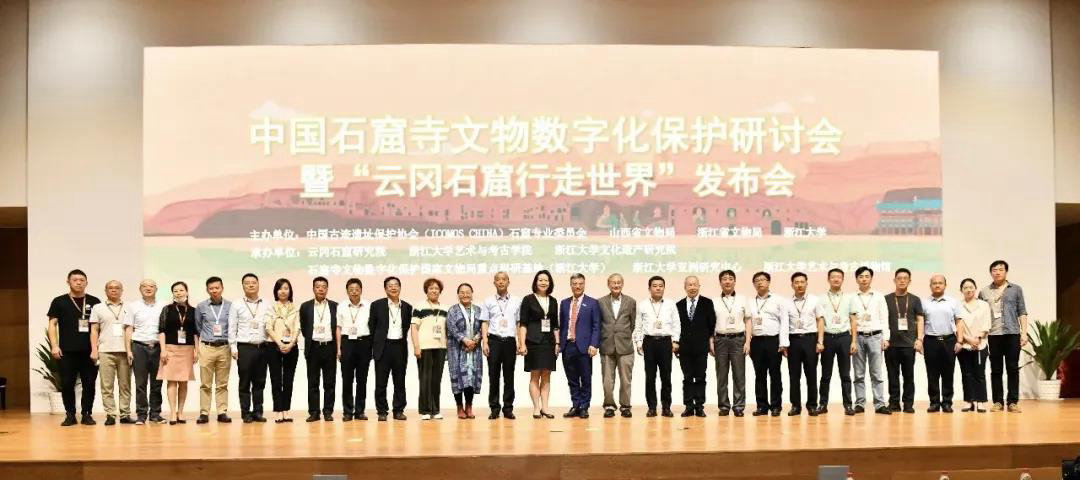 Symposium on the Digital Preservation of China’s Cave Temples and launch of “Yungang Grottoes Travel the World.”
“Our dream of a traveling grotto has finally come true!” said Zhang Zhuo, director of the Yungang Grottoes Research Institute and head of the Yungang Scenic Area Management Committee, after the September 28 launch of Yungang Grottoes Travel the World at Zhejiang University Museum of Art and Archaeology.
Behind him stood the special exhibition “The Majesty of Wei: A Century of Memory and Reproduction at the Yungang Grottoes.” A life-size 3D-printed replica of Cave 12, the Music Cave, rose from the floor to the gallery ceiling. Crowds moved through the colorful, towering grotto as if crossing the boundaries of time and geography. “I've witnessed a miracle,” said a visitor from Hangzhou.
How did this happen?
Digital technology gives Yungang wings
“Technology has given the Yungang Grottoes wings,” said Sun Yingmin, chair of the Grottoes Committee of ICOMOS China, at the launch of Yungang Grottoes Travel the World.
Yungang began exploring digitization in 2003. After the Yungang Grottoes Digital Center was established in 2012, the team began developing its own techniques for conservation and rapidly advanced its work.
In 2016, the Yungang Grottoes Research Institute, Zhejiang University, Wuhan University, Beijing University of Civil Engineering and Architecture, and the Datong Surveying and Mapping Institute established the Digital Yungang Joint Laboratory as a base for research.
In September 2019 the Yungang digitization department issued two Shanxi industry standards covering 3D recording of grotto heritage with close-range photogrammetry and with 3D laser scanning. Both were important for digital conservation in the province. Regular exchanges and joint university projects helped refine the techniques. The team also took on projects beyond Yungang and Shanxi, including digitizing the Temple of King Shun in Shaoxing and the Changling Tomb of the Ming Tombs in Beijing.
“Yungang is now among the national leaders in grotto digitization,” said Ning Bo, director of the institute's digitization department. “We began by learning from pioneers such as Dunhuang, then developed methods suited to Yungang and made significant progress.” He noted that capturing entire three-dimensional cave spaces presents distinctive challenges. Yungang's work in this area laid the foundations for the Cave 12 tour.
Why does the Music Cave travel?
For years the people of Yungang wanted to bring its culture to audiences worldwide, a difficult prospect for immovable caves and sculptures. In discussions with Li Zhirong, deputy director of Zhejiang University's Institute of Cultural Heritage, and Diao Changyu, they proposed jointly printing a monumental Buddha. In December 2017 the two institutions completed a printed copy of the west rear chamber of Cave 3 and installed it at a cultural plaza in Qingdao. News of the large-scale 3D-printed heritage project drew widespread attention.
The same techniques were subsequently used to print full-scale versions of the 20-meter-high Cave 18 and Cave 12, the Music Cave exhibited at Zhejiang University.
Cave 12, the Music Cave, measures 14 meters deep, 11 meters wide and 9 meters high. It presents the splendor of Maitreya's celestial palace. On the upper north wall of the front hall, celestial musicians play instruments including finger whistles, qi drums, panpipes, pipa, transverse flute, qin, five-stringed lute, bili reed pipe, konghou harp, waist drum, beaked flute and conch. Above the lintel dancers move through a sequence of exuberant poses drawn from life, forming part of a festive heavenly concert. The instruments and gestures are an important record of Chinese musical, dance and sculptural history. This ensemble has been called an ancient Chinese “court symphony orchestra.”
“The cave speaks an international language while retaining a strong national identity,” said Xiao Weiwen of Artron Cultural Group. He described plans to develop new business models for museum content, from digital capture and management to new uses, to bring Chinese culture to life. Over the following five years Artron and the Yungang Grottoes Research Institute planned a global tour. Shanghai, Shenzhen, Beijing and Japan were confirmed destinations. Shanghai, the second stop, was to open at year's end, with preparations under way for the later venues.
How will the Music Cave travel the world?
How can something so large be moved and shown thousands of kilometers away?
According to project staff, preliminary research began in 2014. In 2017 Zhejiang University's Institute of Cultural Heritage began collecting high-fidelity 3D data on the Music Cave. Combining laser scanning and photogrammetry, the team spent three months scanning Cave 12 and taking 55,680 photographs. Photogrammetric processing and hands-on 3D editing produced a high-fidelity 3D color model and a precise digital record of the cave and its artifacts.
A new modular process divided the replica into 110 sections, each roughly two meters square, assembled in six tiers. Together the sections weigh around two tonnes, fit into eight standard container trucks and can be assembled for exhibition in a week. One expert called it “a traveling grotto, a Silk Road concert hall whose curtain never falls.” Experts described the project as a series of technical breakthroughs in digital heritage preservation, transmission and use in China.
“From 2014 to 2020 the researchers spent six years making the impossible possible. They had the courage to try something new, the determination to persevere and the attention to detail of true craftspeople,” said Zhang Zhuo.
Looking ahead to a longer journey
During a May 11 visit, Xi Jinping said, “The Yungang Grottoes are a national treasure. Conserving them matters both to China and to the world.” At the tour launch Zhang Zhuo said the Music Cave's appearance at Zhejiang University brought modern technology and traditional art together and set a global precedent for the replication of large heritage sites. “It is only one step. There is much more work ahead.”
Zhang said the Yungang Grottoes Research Institute had implemented the Party's heritage conservation policies and strengthened cooperation with universities and research institutions in China and abroad. It would continue its work on conservation, research and site development. “The Cave 12 project involved laser scanning, large-scale data processing, 3D printing, mechanized assembly and research-based painting. We brought modern technology and traditional art together. We will gradually undertake virtual restoration and digital archaeological surveys at Yungang. In this way we will act on the General Secretary's call to bring cultural heritage to life and take it to the world.”
The Northern Wei dynasty is more than 1,500 years in the past. The Yungang Grottoes are more than 1,500 years old. And the distance from Datong to Hangzhou is just over 1,500 kilometers.
Those 1,500 kilometers are only one step in Yungang's travels. Its journey to the world is under way.