
Who Brought Dunhuang, Yungang and Longmen Together in One Exhibition?
Travelers cover great distances to see China's three great grotto sites at Dunhuang, Yungang and Longmen. On October 18, the exhibition “Splendor of the Silk Road: The Grotto Art of Dunhuang, Yungang and Longmen” opened at Luoyang Museum, bringing the art of all three sites together.
The answer emerged at a symposium on the afternoon of the 19th, marking the twentieth anniversary of Longmen's World Heritage inscription. One word came up repeatedly among the experts: digitization.
◆ The work behind the three-site exhibition: digitization
On opening day, a reporter for Dahe Daily and the Dahe app visited Luoyang Museum. “Awe-inspiring” hardly captured it, the reporter felt. There was also something magical about it, as if a conjurer had been at work.
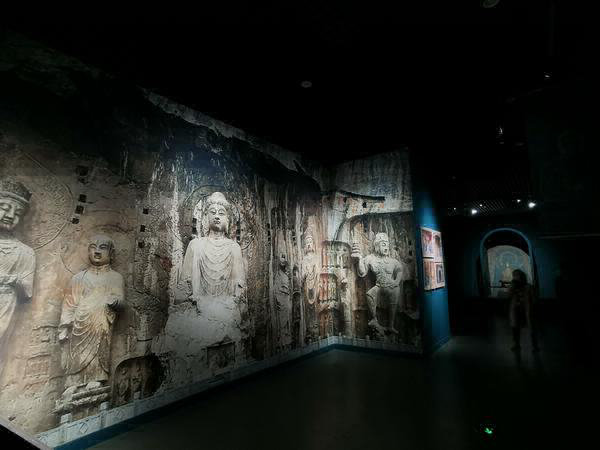
Portable artifacts shared the galleries with monumental sculptures and entire cave settings. Visitors could stand in the museum and feel as if they had arrived at the grottoes themselves.
Three displays stood out: the virtual reconstruction of the Longmen Guanyin and its original colors, a full-scale 3D-printed replica of the Seven Standing Buddhas niche on the south wall of Yungang Cave 13, and three replica caves visitors could enter to experience Dunhuang.
The twentieth anniversary of Longmen's inscription on the World Heritage List provided the occasion. Digitization and 3D printing made the exhibition possible, allowing the caves to travel far beyond their places of origin.
“How can the three great grotto sites meet in Luoyang? Digitization made it possible,” said Li Zhirong, a professor at Zhejiang University's Institute of Cultural Heritage. Dunhuang's paintings could leave their walls, Longmen's Guyang Cave could leave the cliff for the museum, and Yungang Cave 20's Great Buddha could be seen in virtual reality. Once, she said, none of this seemed imaginable.
◆ In the age of 3D printing, replicas of caves and niches travel far from home
In “Crown of the Northern Frontier: Majestic Yungang,” visitors explored 3D-printed niches and virtual caves. A 3D print of the Great Buddha of Cave 20 and a full-scale print of the Seven Standing Buddhas niche from the south wall of Cave 13 made the gallery feel particularly close to Yungang.
Speaking to Dahe Daily and the Dahe app, Zhang Zhuo, director of the Yungang Grottoes Research Institute, said the institute had developed its digital resources in recent years alongside traditional research and conservation.
“Digitizing the grottoes involves collecting, storing and archiving data. With 3D laser scanning we have also entered the age of 3D printing,” he said. “Yungang has made highly accurate, faithful replicas of several caves, allowing the grottoes to travel around the world.”
◆ Digital records underpin research, with many applications still to explore
Digitization has brought cultural heritage from specialist conservation and research settings to the public. Its potential goes further. At the symposium Li Zhirong presented a tree diagram showing uses for cave data in conservation, interdisciplinary research, management, exhibitions and archaeology.
In “Pearl of the Central Plains: Magnificent Longmen,” visitors gathered around the Longmen Guanyin. They admired the bodhisattva's graceful posture and the striking difference between the 3D-printed replicas showing it before and after digital restoration.