 Xuexi Qiangguo, Luoyang Learning Platform, January 7, 2021. “Luoyang, Henan: How the Exhibits from Three Grotto Sites Were Printed.” By Li Lijin. The joint exhibition uses 3D printing to bring cave art from all three sites together.
At the joint grotto exhibition, 3D printing allows visitors to enjoy the art of three major sites in one place. All the digitally produced exhibits came from the same workshop. On December 31, 2020, a reporter visited Shenzhen MIC Technology Co., Ltd. and found that it produced exhibits for Longmen, the Mogao Caves at Dunhuang, Yungang, Qingzhou Museum and numerous other institutions.
Different stone calls for different printing methods
Entering MIC Imaging's workshop in an industrial park in Shenzhen's Bao'an District felt like walking into a miniature grotto museum. Sculptures from Longmen, Yungang and other sites stood everywhere, as staff printed, painted and assembled them. Twenty large FDM 3D printers, each two meters high, operated simultaneously in the workshop. The forms emerged slowly. For the complete replica of Yungang Cave 12, twenty printers ran around the clock for over six months. Coloring took another eight months. In all, it took more than a year to finish the cave, over 11 meters wide and 9 meters high. “This printing method isn't suitable for exhibits from Longmen,” said Chen Shaokang, who leads the company's 3D printing work. Yungang's coarse sandstone limited the detail stonecarvers could cut. Longmen's fine-grained limestone allowed richer, finer detail, which FDM printing could lose. For Longmen, the team used light-cured resin printing, which Chen described as the most advanced and accurate method then in use for cultural heritage.
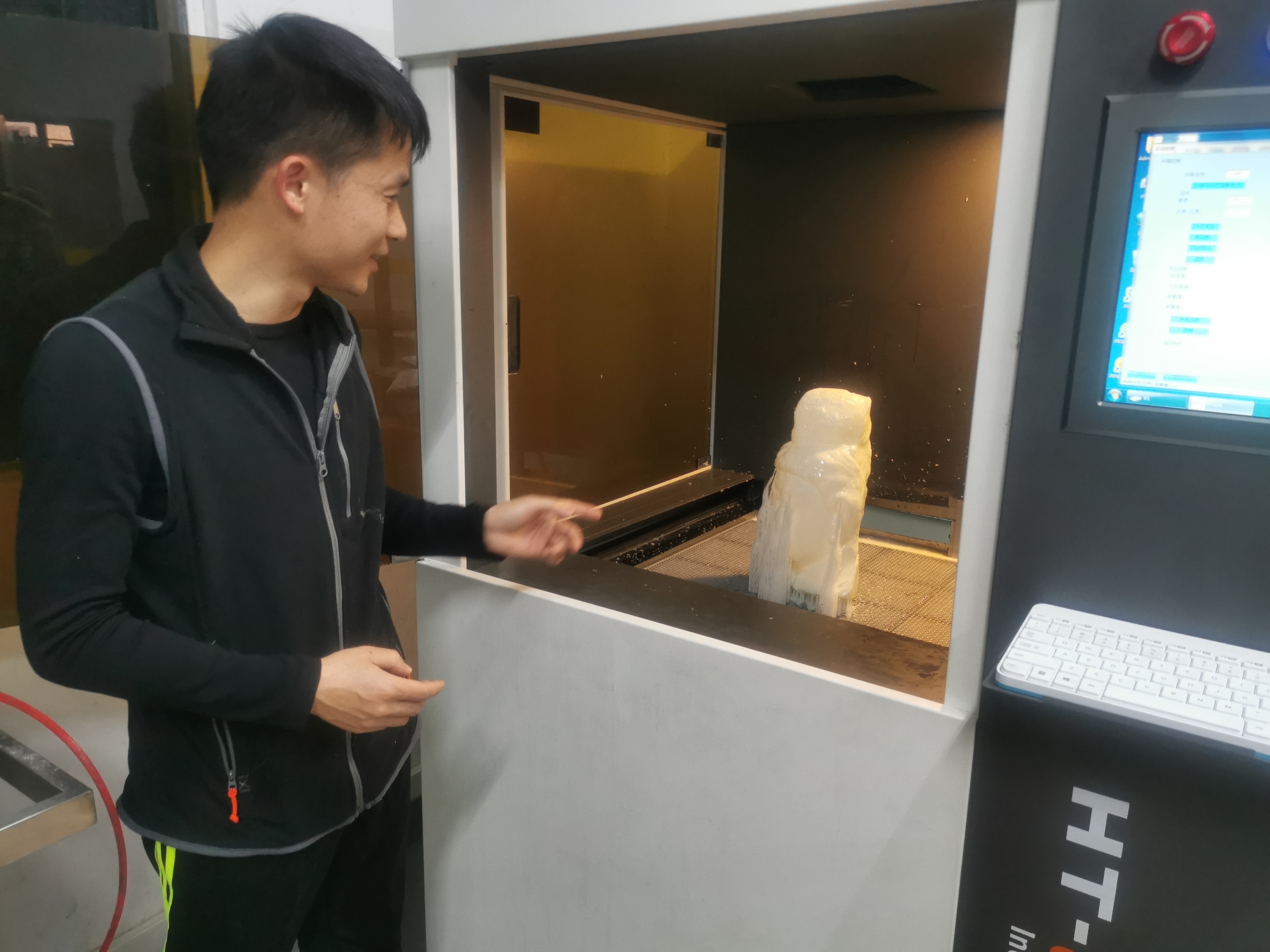
A staff member introduces a 3D-printed Heavenly King. Photo by Li Lijin.
To reproduce the stone's texture, he carried samples back from Mount Longmen.
In another workroom, a freshly printed head of a Heavenly King from Longmen slowly emerged from a milky liquid. The original had been returned to China from overseas. A technician explained that the liquid was photosensitive resin cured by a laser. The platform descended 0.05 millimeters at a time, and each cross-section took 20 seconds to print. A head a little over 20 centimeters tall took about 24 hours. The four niches from Longmen's Guyang Cave — the Duke of Shiping, Yang Dayan, Wei Lingzang and Niche 134 — were printed in the same way. Together they are nearly 10 meters long and about 2.75 meters high. Printing the individual sections alone took three months. Printing the sections is only the first stage. The team then joins them, designs and makes the supporting structure, corrects surface defects, adds texture, and reproduces the colors and surface markings.“Different caves are carved in different kinds of stone, each with its own texture,” said Chen Shaokang. He had brought samples back from Mount Longmen, analyzed their composition with instruments and formulated special coatings so the replicas would have the same surface texture as the Longmen sculptures.
Color and patina matter as much as texture. Colorist Yang Mulan held a 3D-printed bodhisattva head about 30 centimeters high and applied color a little at a time, consulting dozens of high-resolution photographs of the original from different angles. Coloring and aging this small head takes a week, she said. Sometimes an area the size of a fingernail takes half a day. It is the last stage of production.
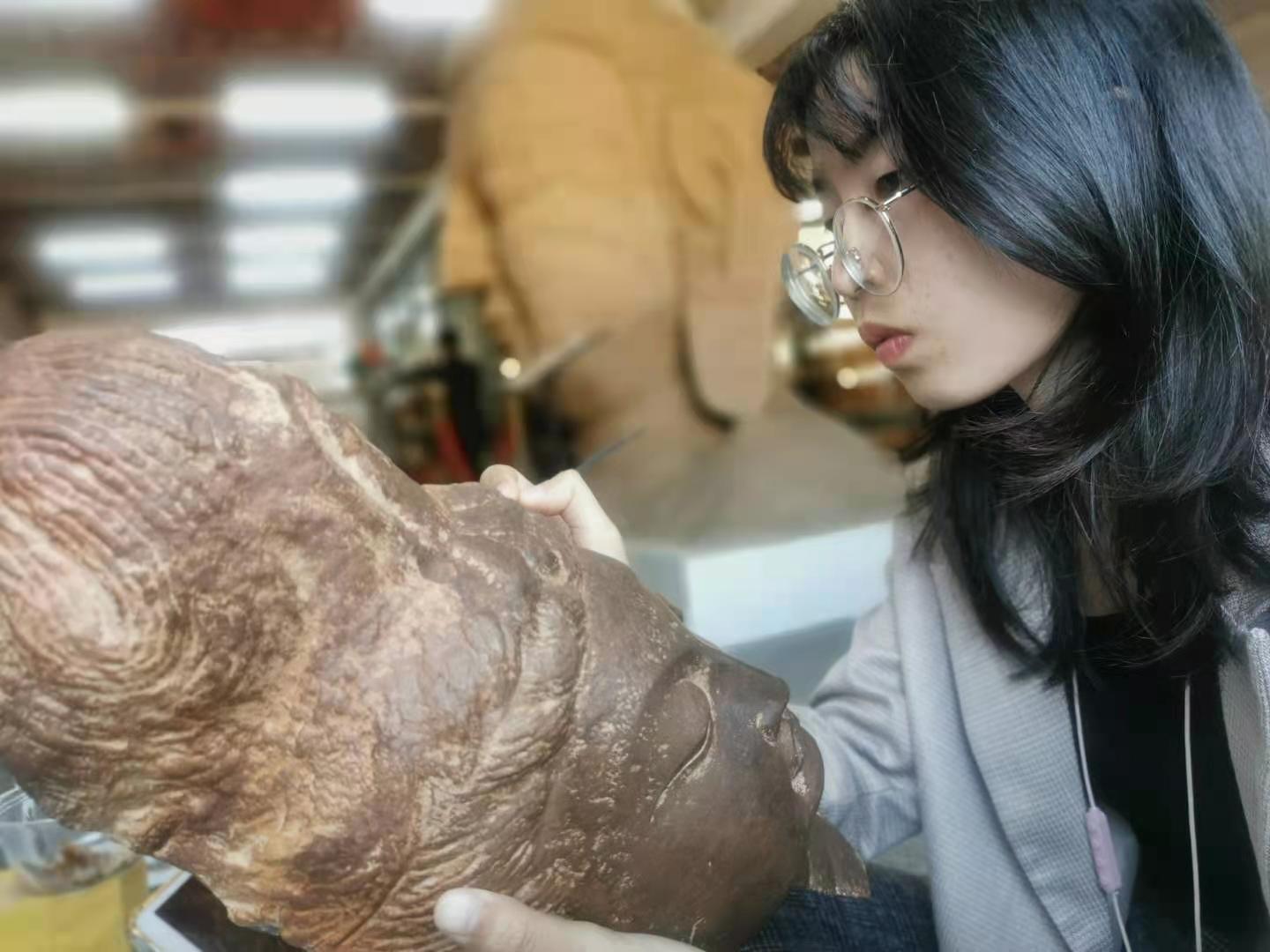
A colorist paints and ages a printed bodhisattva head. Photo by Li Lijin.
All the objects returned from overseas are to be printed.
Li Zhirong, deputy director of Zhejiang University's Institute of Cultural Heritage and head of its digitization team, joined our visit. “Before you can print an object, you have to record it in three dimensions. The more accurate the data, the more precise the exhibit. Conserving and using heritage today also means taking it beyond its site through digitization so more people can see and hear it. Longmen has made a number of valuable experiments in this area. It is an effective way to conserve heritage sites digitally.” Gao Junping, deputy director of the Longmen Grottoes Research Institute's Information and Documentation Center, said that since 2019 the institute, Zhejiang University and MIC Imaging had printed Guyang Cave's four major niches and Gaoshu niche, as well as the head and body of a Buddha at Fengxian Temple. They were now printing several objects returned from overseas.
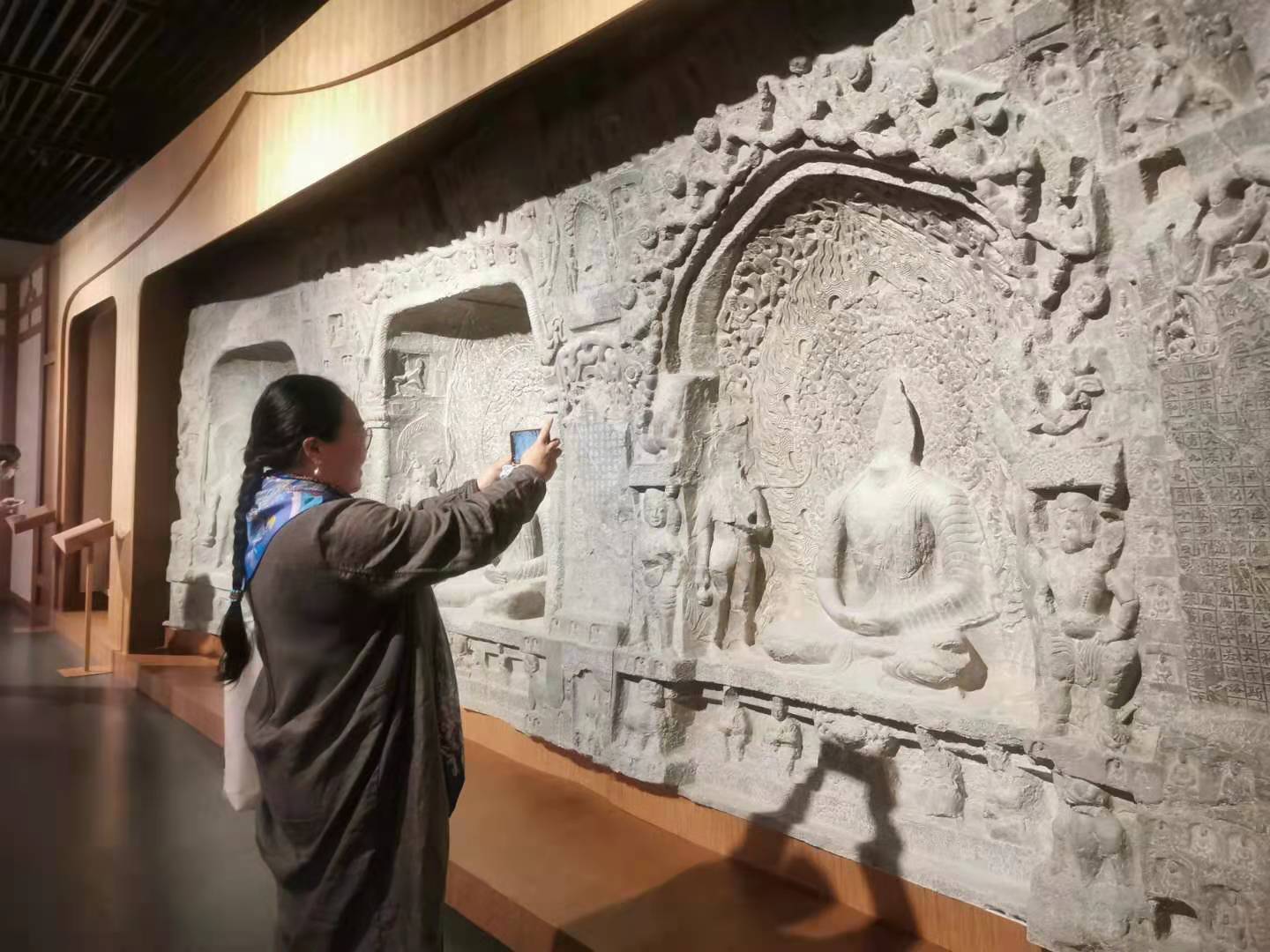
Visitors view the 3D-printed replicas of the four major niches from Guyang Cave. Photo by Li Lijin.
“Of the eight objects returned from overseas, we have printed two and plan to print all of them,” said Gao Junping. The prints will support research on virtual repositioning, show how heads and bodies once fitted together and serve patriotic education. Two major Longmen exhibitions held away from the site in 2020 were well received. To take more of the sculptures to new audiences and to help conserve and pass on this World Heritage Site, the team plans to print more exhibits. By Li Lijin, Luoyang Evening News.Originally published on page A6 of Luoyang Evening News, January 5, 2021.